Bischwiller, Bas-Rhin, Alsace, France in the 1660s
Known then as Bischweiler.
A small Protestant ducal town on the Moder, rebuilding from war and growing through refugee textile work.
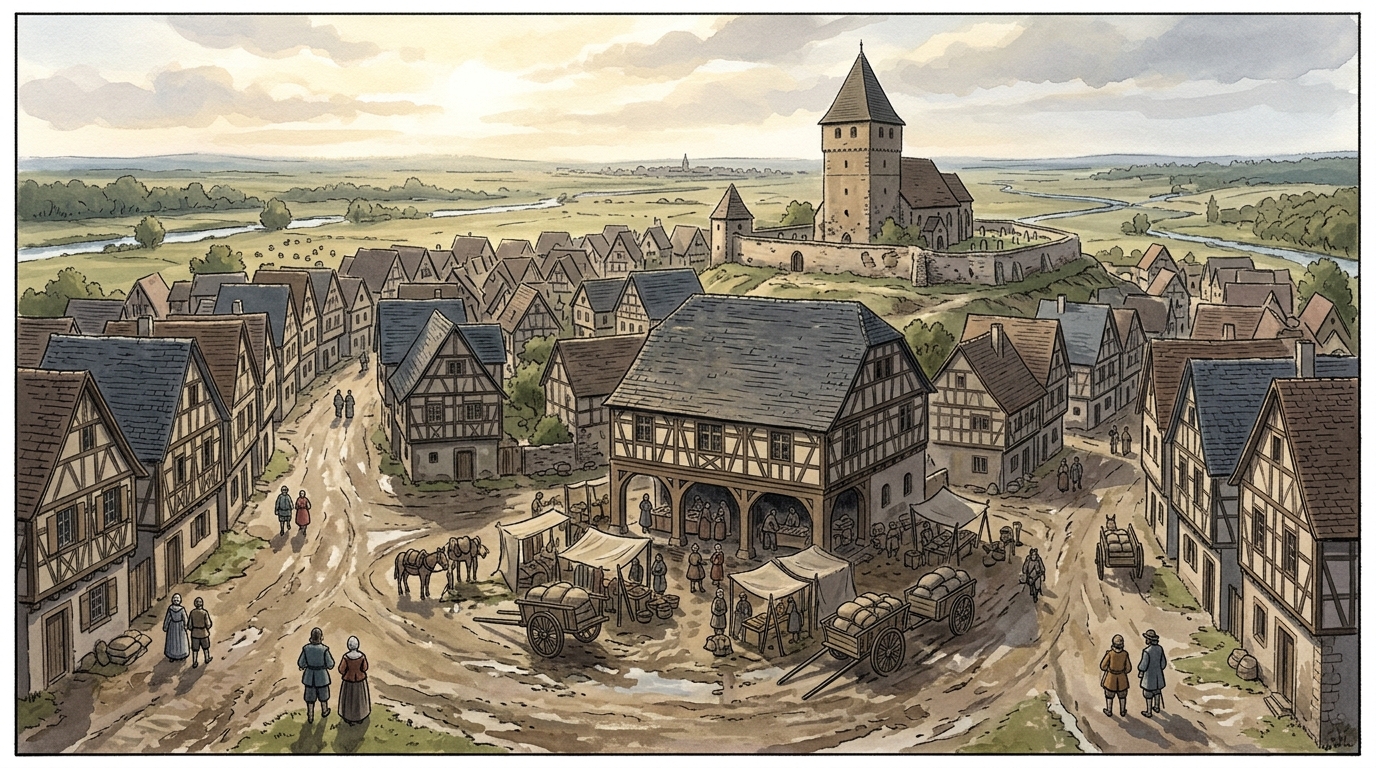
Looking around
You stand near the crossing of the main ways, where the new Laub rises as the common house1 and its arcades hold markets and fairs1. The place is not one village only: toward one side lies the older German-speaking settlement, and toward the other the Welschgass, the French street of Huguenot refugees3. Above the streets is the church on its natural hill2, still a fortified refuge with a walled cemetery2. The castle ground and church carry the memory of fire and occupation in the Thirty Years’ War3. Work turns increasingly to cloth, tanning, and textile trade3, brought by refugees from Lorraine, the Ardennes, Picardy, and the Spanish Netherlands. The town is under the Protestant princes of Deux-Ponts-Birkenfeld2, while the wider Alsatian world is being drawn under French power after Westphalia. Beyond the houses run the Moder and the Rothbächel3, with Haguenau close enough to matter.
Work
Cloth after ruin
The most distinctive work is refugee work: tanners, clothmakers, and cloth merchants3 help turn Bischweiler toward wool and textile manufacture. Farming, herding, and domestic service also matter, as across the repopulating Lower Alsace region, where Swiss migrants often became servants, farmers, shepherds, or artisans5.
Faith
Many Protestants, not one
The town is Protestant, but not simple: German-speaking and French-speaking Protestants, Reformed and Lutheran2, live beside one another. The church is both sanctuary and strong point, a refuge in wartime, with a crenellated wall and a cemetery2.
Law & power
Duke, town, France
Local authority runs through the Protestant princes of Deux-Ponts-Birkenfeld2 and their officers. At the street crossing, the new Laub rises as the common house1, holding administration as well as trade.
In the air
Confession and protection
The great argument is whether rulers may force religion. After 1648, France’s claims in Alsace are real, but Protestant worship that had existed before 1 January 1624 was protected4 in many places.
What people feared
War remembered nearby
The decade stands in the shadow of the Thirty Years’ War: fire and occupation in the Thirty Years’ War3 are within living memory. A fortified church on a hill shows what fear had taught the town.
Home & table
Two village halves
Daily life is divided by language and settlement. One side is the older German-speaking place; the other is Welschgass, the French street of Huguenot refugees3.
Money
Markets, not prices
Trade gathers under the Laub, where arcades hold markets and fairs1. Exact household costs are a gap: no online source found here gives ordinary wages, bread prices, rent, or tax levels for the 1660s.
Roads & news
Roads through Alsace
News comes with traders, refugees, officials, and church traffic along the roads and river country. Haguenau matters because Bischweiler is near the imperial city of Haguenau4, whose politics toward France are watched across the region.
Year by year
- 1659Seigneurial measures encouraged repopulation and cultivation in the wider Hanau-Lichtenberg and Lower Alsace region. nearby5
- 1660The Stuart monarchy was restored in England, a major European Protestant and diplomatic event that educated clergy and officials could hear about. the world
- 1662A royal ordinance formed part of the wider postwar effort to repopulate and recultivate Alsace. nearby5
- 1665The Laub was built as Bischweiler’s common house at the meeting point of the main streets. here1
- 1667A bell made by Melchior Edel and given by Duke Christian II was installed for the Laub’s turret. here1
- 1667Swiss immigration into the Hanau-Lichtenberg region reached one of its peaks. nearby5
- 1667The War of Devolution began between France and Spain, reminding Alsace that Louis XIV’s frontiers were still moving. the country
Pictures from the time
_Porte_Dor%C3%A9e,_7-12-24_(football)_association,_%C3%A9quipe_de_Bischwiller_-_btv1b53139871w.jpg)
What the sources say
- The Laub, Bischweiler’s common house and later town hall, was built in 1665 under Duke Christian II of Birkenfeld-Bischweiler. from the sources1
- The Laub stood at the intersection of the principal streets and held administrative services, markets, and fairs under its arcades. from the sources1
- Huguenot refugees admitted by the prince from 1617 or 1618 formed a French-speaking quarter called Welschgass, now Rue Française. from the sources3
- The parish church stood on a natural hill, the Kirchberg. inferred2
- The church served both as a place of worship and as a refuge in wartime, with a crenellated wall and a cemetery around it. inferred2
- During the Thirty Years’ War Bischweiler was repeatedly damaged; Austrian troops occupied it, Mansfeld’s troops sacked it, and Swedish forces under Christian of Birkenfeld took it in 1633. from the sources3
- Many Huguenot settlers were tanners, clothmakers, and cloth merchants, and they helped establish a wool and textile industry in Bischweiler. from the sources3
- Bischweiler belonged to the Protestant dukes or princes of Deux-Ponts-Birkenfeld in this period. inferred2
- Bischweiler lay on the Moder; Hanhoffen, associated with Bischwiller, lay by the Rothbächel, a tributary of the Moder. from the sources3
- By the 1660s the town had German-speaking and French-speaking Protestant communities, with Reformed and Lutheran divisions remaining socially important. inferred2
- The Protestant parish history says services could easily last three hours, and later overcrowding forced enlargement of the church in 1722. inferred2
- A bell dated 1667 was supplied by the founder Melchior Edel and given by Duke Christian II for the Laub’s octagonal turret. from the sources1
- After the Treaties of Westphalia in 1648, France held major rights in Alsace, but Protestant worship that had existed before 1 January 1624 was protected in many places. from the sources4
- The wider Hanau-Lichtenberg and Lower Alsace region was being repopulated after wartime losses through seigneurial measures in 1651 and 1659 and a royal ordinance in 1662. from the sources5
- Swiss immigration into the Hanau-Lichtenberg region peaked in 1667; most migrants came from the German-speaking Reformed cantons, especially Bern. from the sources5
- Swiss migrants in the region often became servants, farmers, shepherds, or artisans before gaining fuller civic status. from the sources5
- Bischweiler’s surviving online sources do not give a reliable population total for the 1660s. not known
- No online source found here gives ordinary wages, bread prices, rent, or tax levels for Bischweiler in the 1660s. not known
- The town was close to the imperial city of Haguenau, one of the Alsatian Decapolis towns that did not immediately accept French control after Westphalia. from the sources4
Sources
- Musée de la Laub. Wikipédia
- Paroisse protestante de Bischwiller: Histoire. Paroisse protestante de Bischwiller
- Bischwiller. Wikipedia
- L’Alsace au XVIIe siècle. Musée protestant
- Compte rendu: W. Bodmer, L’immigration suisse dans le comté de Hanau-Lichtenberg au XVIIe siècle. Revue d’histoire moderne, 1930
Bischwiller in other decades
Nearby, about the same time
Did someone of yours live here?
Give Yore one name and it goes looking for the family, then tells it back as a film set in places like this one, with the record behind every sentence.
Researched by Yore’s AI historian (gpt-5.5) in October 2026 from the sources above. It is about the place and the time, not about any person. Statements marked “inferred” are conclusions drawn from the sources, not records. Also available as plain Markdown. To cite: Yore, “Bischwiller, Bas-Rhin, Alsace, France in the 1660s”, yorehistory.com/place/bischwiller-alsace-france/1660s