County Antrim, Ireland in the 1710s
A linen-growing, Presbyterian-majority Ulster county, governed by landlords, courts, and an established church many inhabitants did not belong to.
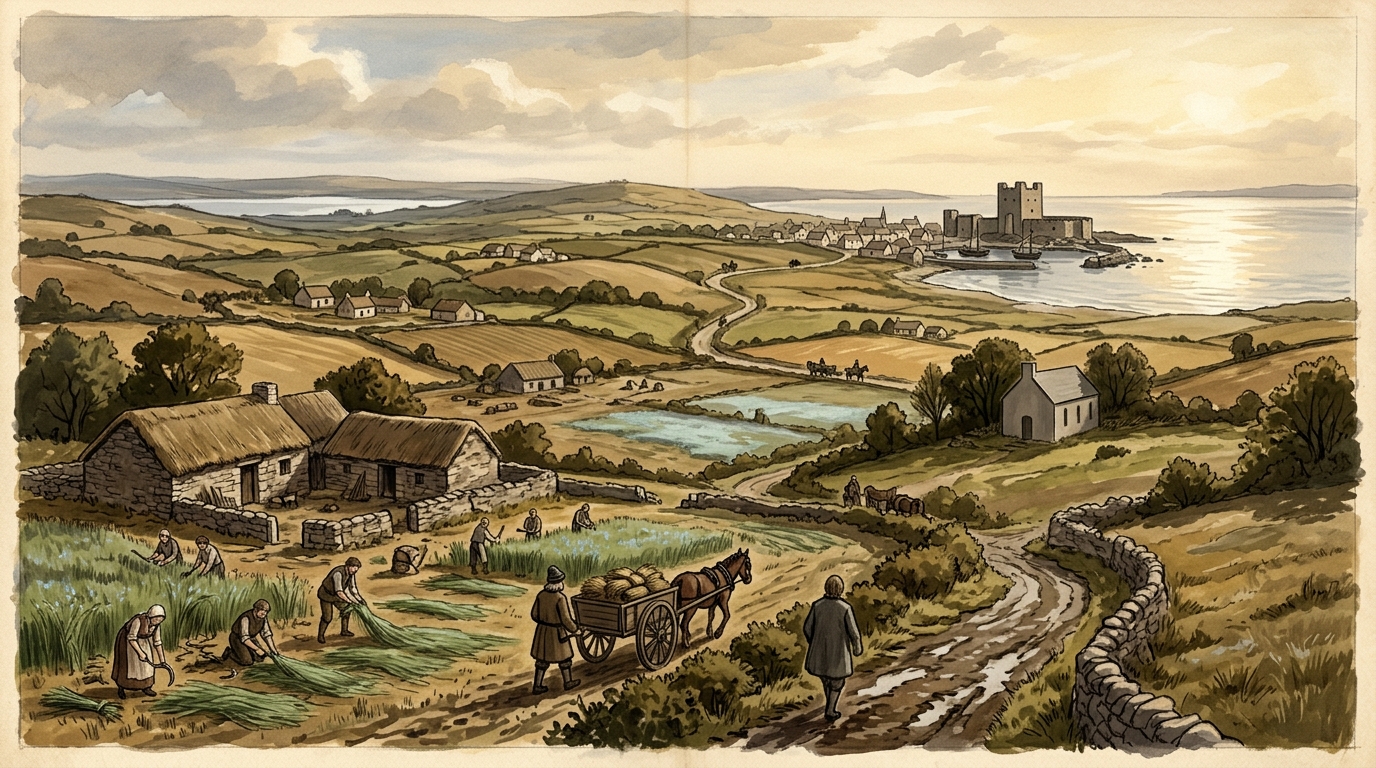
Looking around
You stand in a county, not a single village: eastward are Carrickfergus Bay and the road to Belfast1, westward Lough Neagh1, and northward the Glynnes and the Route1. Around farms, flax is being raised for linen2, and much of the making is still domestic work on farms rather than factory work7. In market towns and ports, merchants look toward Belfast, the grand mart of the linen manufacture2, while county law and jail business still pull people toward Carrickfergus, the assize town8. Meeting houses stand in plainer, less conspicuous places: Presbyterians form an absolute majority in Antrim4, but the law favors the Church of Ireland5. A stranger may hear of departures: by 1718, families from Ulster are already passing toward New England4, complaining of hardship, tithes, and limited rights.
Work
Flax, webs, and farms
The telling work is linen: flax is cultivated2, and, as across Ulster, linen production is still domestic farm work7. The county sits close to Belfast, the grand mart of the linen manufacture2.
Faith
A dissenting majority
Presbyterians form an absolute majority in Antrim4, but the Church of Ireland is the established church5. Meeting-house life matters, yet its people face legal limits.
Law & power
Landlords and Anglican tests
County politics is shaped by great landed interests such as Antrim, Massereene, Donegall, and Hertford3. The 1704 Test Act excludes Presbyterians from public office5 unless they conform by Anglican communion.
In the air
Subscription and conscience
The argument inside Presbyterianism is over doctrine: must ministers subscribe to the Westminster Confession?5 John Abernethy of Antrim5 stands near the center of that dispute.
Money
A trade taking off
The scale is changing fast: linen exports are put at no more than £6,000 a year when the 1711 Linen Board is founded2, but by 1730 they exceed £400,0002.
Who lived here
Scottish, Irish, Protestant, Catholic
Antrim is part of the Ulster settler world: Presbyterians are an absolute majority4, while Catholics and Anglicans remain present under an unequal church and political order.
Roads & news
Courts, ports, and departures
County business draws people to Carrickfergus, the assize town8. News and strangers come by roads, carts, horses, coastal shipping, and lough traffic, and talk includes families leaving Ulster for New England4.
Home & table
Records thin at hearth level
For an ordinary house, the surviving online record thins out: no full online description fixes Antrim interiors, diets, or weekly wages specifically for the 1710s.
Year by year
- 1710Irish linen cloth exports reached 1,688,574 yards in the year ending 25 March 1710. the country9
- 1711The Linen Board was created to encourage and regulate Irish flax and hemp manufacture. the country2
- 1713A contested Belfast election was reported as carried by the Tories, 117 votes to 109. here
- 1714George I succeeded Queen Anne, making Hanoverian loyalty a practical question for officeholders and churches. the country
- 1715Irish linen cloth exports reached 2,153,120 yards in the year ending 25 March 1715. the country9
- 1715The Jacobite rising in Scotland and northern England would have been worrying news in heavily Scottish Presbyterian Ulster. the world
- 1718Ulster families were reported passing toward New England in large numbers, with tithes and hardship named among their complaints. nearby4
- 1719The Toleration Act gave Presbyterians official recognition in Ireland. the country5
Pictures from the time

What the sources say
- County Antrim's older divisions included North or Lower Clandeboy, stretching from Carrickfergus Bay and the Lagan toward Lough Neagh. from the sources1
- Lower Clandeboy included the tract that later formed the baronies of Belfast, Massareene, and Antrim, placing Lough Neagh at the county's western side. from the sources1
- The Glynnes ran from Larne northward along the coast to Ballycastle, backed by mountains; the Route covered much of the county's north and west. from the sources1
- Linen manufacture in the north of Ireland depended on flax cultivation, which government-backed improvers encouraged after the late seventeenth century. from the sources2
- Across Ulster in the eighteenth and early nineteenth centuries, linen production was largely a domestic industry on farms before later factory industrialization. from the sources7
- Samuel Lewis later described Belfast as the grand mart of the linen manufacture, with Lisburn and its surrounding country especially active. from the sources2
- Carrickfergus was the assize town for County Antrim until the nineteenth century, before Belfast displaced it. inferred8
- A history of Scots in Ulster says Presbyterians formed an absolute majority in County Antrim by the later seventeenth century. from the sources4
- The Church of Ireland was the established state church, while Presbyterian ministers and congregations dissented from episcopal church government. from the sources5
- In 1718, an Ulster estate agent in County Monaghan noted one hundred families passing in a week toward New England, complaining especially of tithes owed to Church of Ireland clergy. from the sources4
- The Irish Linen Board was established by an act passed in 1711, when Irish linen exports were said not to exceed £6,000 a year. from the sources2
- By 1730, Irish linen exports had risen to more than £400,000 a year, showing how quickly the trade was growing after the 1710s. from the sources2
- Ireland exported 1,688,574 yards of linen cloth in the year ending 25 March 1710 and 2,153,120 yards in the year ending 25 March 1715. from the sources9
- Before the 1800 Union, County Antrim sent ten members to the Irish parliament: two county knights and two each for Antrim, Belfast, Lisburn, and Randalstown. from the sources1
- The main county political interests later visible in Antrim elections were great landed families including Antrim, Hertford, Massereene, Donegall, Upton, and Langford or Rowley. from the sources3
- The 1704 Irish Test Act required public officeholders to prove Anglican communion, effectively excluding Presbyterians from local government. from the sources5
- Presbyterians in Ireland received official recognition under the 1719 Toleration Act. from the sources5
- The first major early-eighteenth-century Irish Presbyterian dispute concerned whether ministers must subscribe to the Westminster Confession of Faith. from the sources5
- John Abernethy of Antrim led the party later called New Lights or Non-Subscribers in the subscription controversy. from the sources5
- Jonathan Bardon estimated about 200,000 Presbyterians in Ulster by 1714, out of a provincial population of about 600,000. from the sources6
- Presbyterian registers can reach back to the late seventeenth century, but most surviving Presbyterian baptism and marriage registers date from the nineteenth century. from the sources5
- No full online description fixes ordinary County Antrim house interiors, diets, or weekly wages specifically for the 1710s. not known
- There was no railway in County Antrim in the 1710s; movement was by road, horse, foot, cart, coastal shipping, and river or lough traffic. inferred
- Because the place is known only as County Antrim, this account describes a broad county world rather than a single townland or parish. not known
Sources
- Samuel Lewis Topographical Dictionary: County Antrim. Ballycastle History / Samuel Lewis, 1837
- Linen Manufacture in County Antrim - Topographical Dictionary of Ireland. Library Ireland / Samuel Lewis, 1837
- County Antrim: Irish Parliament Constituencies and Elections. Ulster Historical Foundation
- The Scots in Ulster. Ulster-Scots Agency
- The Story of the Presbyterians in Ulster. Discover Ulster-Scots
- The Presbyterians of Ulster, 1680–1730. Boydell & Brewer preview, 2013
- The Belfast Linen Industry. OpenLearn, The Open University, 2023
- The Hiring Fair: County Antrim. Ireland's Eye
- History of the Commercial and Financial Relations between England and Ireland, Part 8. CELT, University College Cork
County Antrim in other decades
Nearby, about the same time
Did someone of yours live here?
Give Yore one name and it goes looking for the family, then tells it back as a film set in places like this one, with the record behind every sentence.
Researched by Yore’s AI historian (gpt-5.5) in November 2026 from the sources above. It is about the place and the time, not about any person. Statements marked “inferred” are conclusions drawn from the sources, not records. Also available as plain Markdown. To cite: Yore, “County Antrim, Ireland in the 1710s”, yorehistory.com/place/county-antrim-ireland/1710s