Easton, Northampton County, Pennsylvania in the 1760s
A small county-seat river town, German and English, where courts, ferries, churches, and Indian diplomacy met at the frontier’s edge.
Looking around
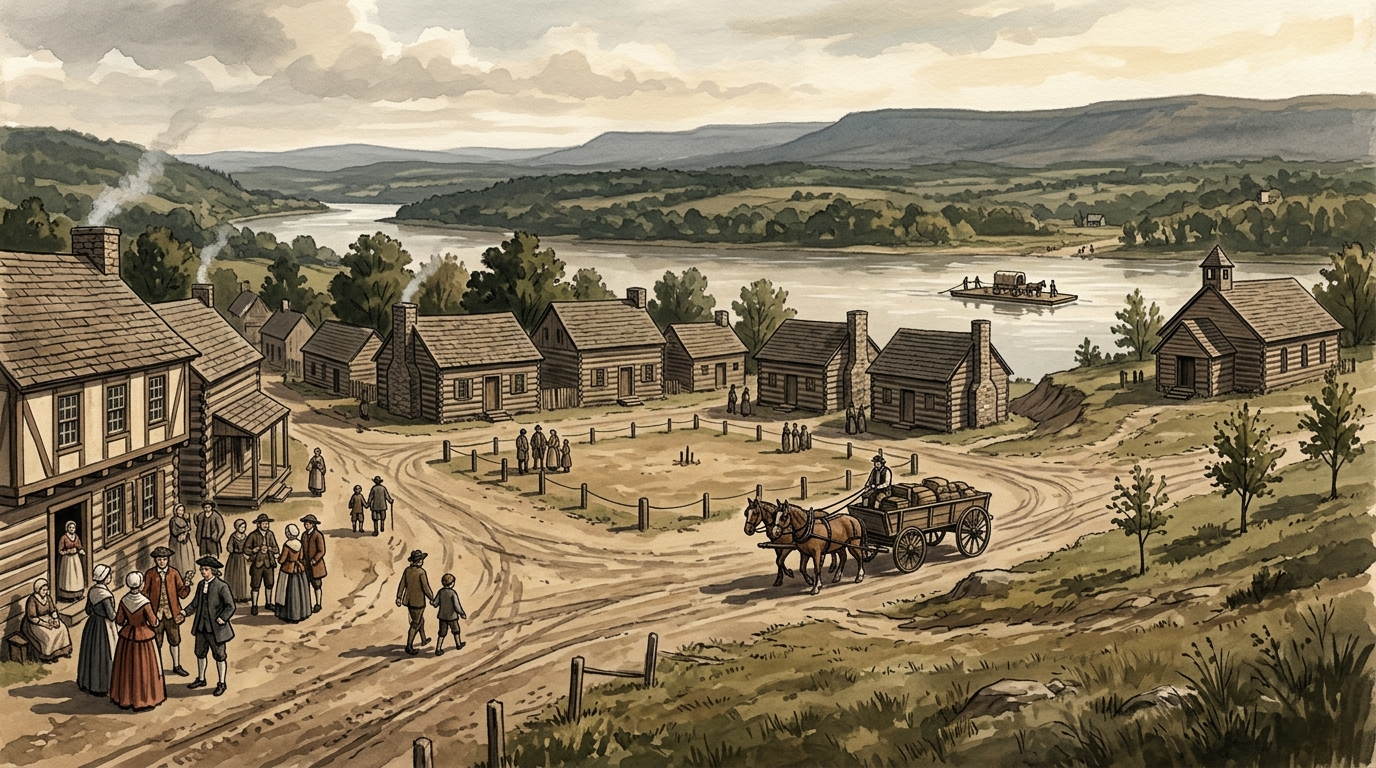
You stand at the Great Square9, where an 80-by-80-foot courthouse lot9 has been laid out and county business draws people in. Around it are log houses1 and taverns that serve those who come for court. The town is small: about 150 people in 17601,2 and perhaps 350 by 17701,2. Turn east and the ground drops toward the Delaware5, where Martin’s ferry5 carries travelers, wagons, and goods toward New Jersey. Turn south and west and the Lehigh joins the Delaware5,6 at the Forks. Roads run out from here toward Bethlehem, Allentown, Reading, Lancaster, York, New York City, and New England4. Nearby stands the combined church and schoolhouse2 begun by Protestant settlers; much of the worship around the county is Reformed and Lutheran4. Beyond town, Blue Mountain4,6 and the limestone valley shape the farms and roads.
Work
Court days paid
The county seat brought work: four times a year4 the town filled for court, and taverns and shops lived from those visits. Outside town, as across Northampton County, people worked at farming, milling, tavern keeping, trades, and court-day commerce4.
Faith
German Protestant ground
Easton’s first public religious building was practical: a schoolhouse and occasional church2 raised by Protestant subscription. Across the county, Reformed and Lutheran congregations4 were the strongest church presence.
Law & power
Courthouse authority
Power is concentrated at the square: Northampton was created in 17526,4, and Easton held the first county court6 that June. The 80-by-80-foot courthouse lot9 in the Great Square shows how law, land, and the Penn proprietors met here.
In the air
Taxation and resentment
Politics were not distant: Northampton had only one representative4 in the Pennsylvania Assembly, and this fed resentment. In 17654,7, the Stamp Act turned that resentment toward Parliament as well.
What people feared
Frontier memory lingered
The decade followed years of war and Indian diplomacy: the Treaty of Easton3 had brought colonial officials and many Native nations here in 1758. The ferry and roads made Easton useful, but also exposed it to every rumor and alarm moving along the frontier routes.
Home & table
Small log town
The built place was still raw: streets cleared of forest remnants1 and log houses1 belonged to living memory. The population was tiny, rising from about 150 in 17601,2 to about 350 in 17701,2.
Money
Shillings for street work
One local figure survives clearly: men cleaning Easton’s early streets were said to earn 3 shillings per day1. Other ordinary prices are harder to recover, since no local price list for the decade was found online.
Roads & news
Ferry road crossroads
News arrives by water and road. Martin’s ferry5 carried travelers across the Delaware, and Easton stood on routes toward New York, New England, Bethlehem, Allentown, Reading, Lancaster, York, and the Shenandoah Valley4.
Year by year
- 1758The Treaty of Easton brought Pennsylvania and New Jersey officials together with many Native nations at the town. here3
- 1762The Penn proprietors granted a lot in the center of Easton’s Great Square for the county courthouse. here9
- 1763The Seven Years’ War ended, and frontier Pennsylvania lived with the consequences of war, diplomacy, and British imperial rule. the country
- 1763The Royal Proclamation tried to restrict colonial settlement west of the Appalachians, a policy people on Pennsylvania’s frontier would have heard argued over. the country
- 1765The Stamp Act crisis reached Northampton County, where inhabitants resisted the new imperial tax. here4,7
- 1766The first Northampton County courthouse opened at Easton. here8
- 1768The Treaty of Fort Stanwix redrew the line of colonial land claims and Native dispossession in Pennsylvania and beyond. the country
What the sources say
- Easton’s population was estimated at about 150 in 1760 and 350 in 1770. from the sources1,2
- A local history says early Easton’s streets had to be cleared of forest remnants and that log houses were built as the settlement grew. from the sources1
- Workers cleaning Easton’s primitive streets were said to have been paid 3 shillings per day. from the sources1
- German Protestant settlers began raising money in 1755 for a building to serve as both schoolhouse and occasional church for Protestant ministers. from the sources2
- Easton stood at the Forks of the Delaware, where the Lehigh River meets the Delaware River. from the sources5,6
- David Martin’s ferry at the Forks operated under grants received in 1739 and 1741 and remained an important westward route crossing until 1806. from the sources5
- Northampton County was created from Bucks County on March 11, 1752, and Easton was made the county seat. from the sources6,4
- The first Northampton County court was held at Easton in June 1752. from the sources6
- A jail was built at Easton in 1754, before the first full courthouse was completed. from the sources6
- In 1762 the Penn proprietors granted an 80-by-80-foot lot in the center of Easton’s Great Square for the county courthouse. from the sources9
- The Northampton County courthouse was under construction in the mid-1760s and opened in 1766, with a Moravian-cast bell added two years later. from the sources8
- The great Treaty of Easton had been held in town in October 1758 with Pennsylvania and New Jersey officials and representatives of Mohawk, Oneida, Onondaga, Cayuga, Seneca, Tuscarora, Delaware, Shawnee, Nanticoke, Conoy, Minisink, Mohican, and other Native groups. from the sources3
- Across Northampton County by the early 1770s, Reformed and Lutheran congregations greatly outnumbered other churches. from the sources4
- Northampton County stretched across the Lehigh Valley and Blue Mountain country; Kittatinny, or Blue Mountain, formed a major ridge through the county. from the sources4,6
- By the early 1770s Easton lay on a primary inland highway, with routes by ferry and road toward New York, New England, Bethlehem, Allentown, Reading, Lancaster, York, and the Shenandoah Valley. from the sources4
- Four times a year Easton’s population swelled when inhabitants and officials came for quarter sessions court. from the sources4
- Northampton County was limited to one representative in the Pennsylvania Assembly when the county was created, a political arrangement that later fed resentment against Philadelphia authorities. from the sources4
- Northampton inhabitants resisted the Stamp Act in 1765, part of a wider provincial and imperial argument over taxation and rights. from the sources4,7
- By 1774 Northampton County had about 15,000 inhabitants, and persons of German ancestry made up close to 80 percent of them. from the sources4
- As across rural Northampton County, most households depended on farming, milling, tavern keeping, trades, and court-day commerce rather than on factory work. from the sources4
- No detailed online description was found for the ordinary interiors of Easton houses in the 1760s. not known
- No local price list for bread, meat, rent, or ferry fares in Easton during the 1760s was found online in this search. not known
Sources
- The History with Reminiscences of the Early Taverns and Inns of Easton. Penn State University Libraries digital collection
- Some of the First Settlers of “The Forks of the Delaware” and Their Descendants. Library of Congress
- Treaty of Easton, 1758. Indigenous Digital Archive / Oklahoma State University, 1758
- Sweet Land of Liberty: The Ordeal of the American Revolution in Northampton County, Pennsylvania. Penn State University Press, 2000
- David Martin’s Ferry. HistoricSiteMarkers.com / Pennsylvania Historical and Museum Commission marker text
- Northampton County, PA History. PA-Roots
- Resolves of the Pennsylvania Assembly on the Stamp Act, September 21, 1765. American Battlefield Trust, 1765
- History of the Court. Northampton County Court of Common Pleas
- Stuart v. City of Easton, 170 U.S. 383. OpenJurist, 1898
Nearby, about the same time
Did someone of yours live here?
Give Yore one name and it goes looking for the family, then tells it back as a film set in places like this one, with the record behind every sentence.
Researched by Yore’s AI historian (gpt-5.5) in October 2026 from the sources above. It is about the place and the time, not about any person. Statements marked “inferred” are conclusions drawn from the sources, not records. Also available as plain Markdown. To cite: Yore, “Easton, Northampton County, Pennsylvania in the 1760s”, yorehistory.com/place/easton-northampton-county-pennsylvania/1760s