Nürnberger Strasse, Erlangen, Bavaria, Germany in the 1910s
Known then as Erlangen.
A small Bavarian university and garrison town was becoming an industrial town, with war soon turning workshops, streets, and households toward the front.
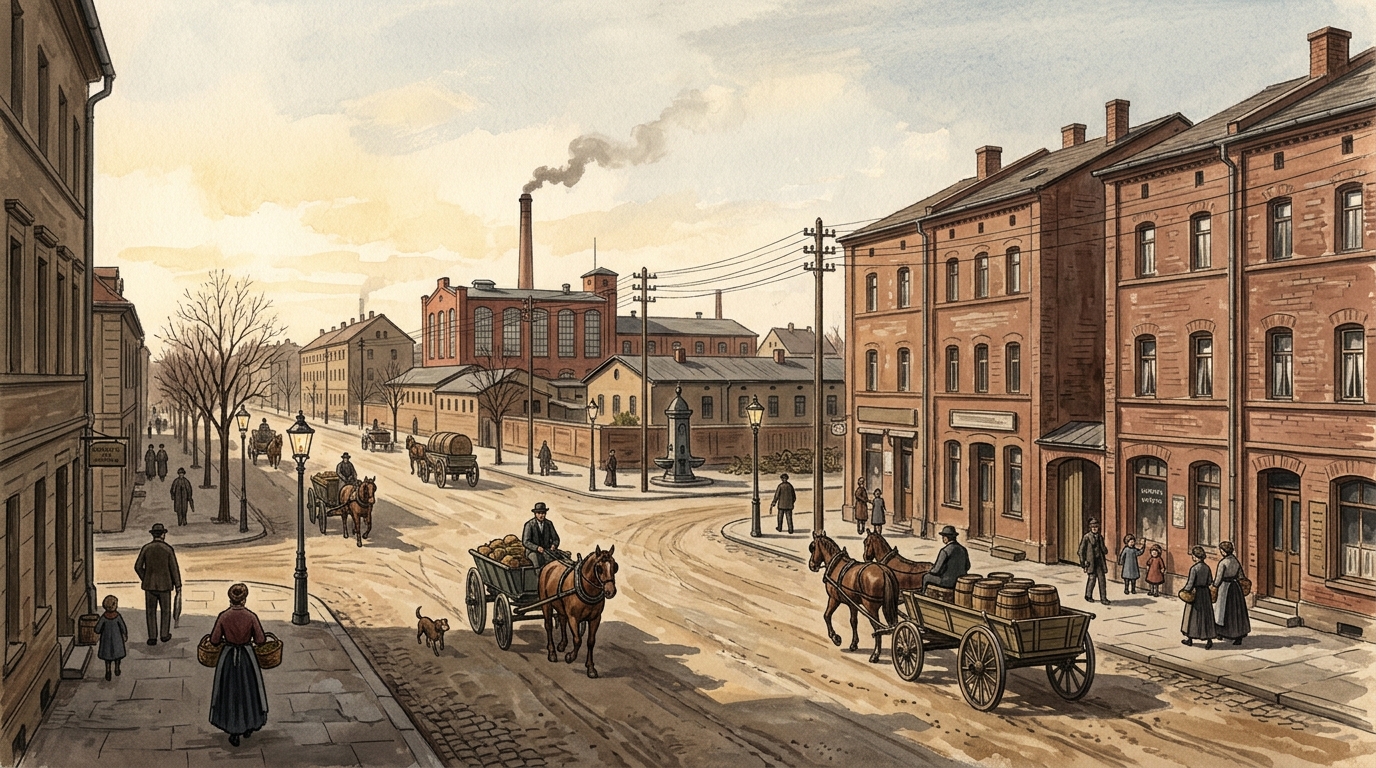
Looking around
You stand on Nürnberger Straße, the road whose name points south toward Nuremberg. Around this part of Erlangen the town is no longer only the old baroque core: its population has just reached nearly 25,0004, and building is pushing outward. To the east lie new streets and three-storey brick tenements4 of the Zollhaus quarter, with shops or workshops in ground floors and rear buildings. Not far away, at Luitpoldstraße, rises the brick factory complex of Reiniger, Gebbert & Schall5, maker of electro-medical apparatus. Further east are the artillery barracks8, part of the garrison world. Pipes and wires are part of daily life now: almost all houses have municipal drinking water2, and electric light reaches a small but growing number of customers2. The town still belongs to the Kingdom of Bavaria and the German Empire, but by 1914 war is about to reorder the street.
Work
Mechanics and factory hands
The most telling workplace nearby was Reiniger, Gebbert & Schall5, whose apparatus business had moved to the edge of town in 1893. Around the eastern expansion streets lived factory workers, foremen, mechanics, artisans, and small shopkeepers4.
Faith
Mostly Protestant town
The wider Erlangen district counted 16,693 Protestants and 7,720 Catholics in 19109. A small Jewish community was present too, with 224 people in 19107.
Law & power
Magistrate, king, empire
Local decisions mattered: the magistrate decided in 1910 to build a new gasworks2. Above it stood the Kingdom of Bavaria and the German Empire, until revolution ended both in 1918.
In the air
Social democracy nearby
In the Zollhaus quarter east of the old town, politics leaned working-class: it was socially democratic in character4 and organized socially through many taverns4.
What people feared
War reaches the workshop
After 1914, danger was not abstract: at RGS, many workers were called to the front5. The factory itself was pulled into the war economy as increasing capacity went to war production5.
Home & table
Tenements and services
Nearby working households often lived in three-storey brick tenements4. By this decade many homes had modern services: almost all houses had drinking-water connections2, though not every home had electricity.
Money
A growing town economy
Erlangen’s growth came from industrialization and the garrison: the population had roughly doubled by 19104. War disrupted ordinary business when RGS lost markets5 and reoriented production.
Roads & news
Rail, telephone, papers
News and strangers arrived by rail, including the Seku secondary railway4 around the south of town. Faster messages existed but were limited: the telephone network was used mostly by businesses and public institutions2.
Year by year
- 1910Erlangen reached just under 25,000 inhabitants after decades of industrial and garrison growth. here4
- 1910The magistrate decided to build a new gasworks for the growing town. here2
- 1911Plans were being discussed for a direct electric tram or rapid connection between Nuremberg and Erlangen. nearby6
- 1913The RGS factory complex was enlarged or altered with buildings dated 1911/13 and an upper storey added in 1913. here3
- 1914The First World War began, taking workers and soldiers from Erlangen into military service. the country5
- 1916Reiniger, Gebbert & Schall took over the troubled Veifa-Werke during the war economy. here5
- 1918The November Revolution ended the Bavarian monarchy and the German Empire. the country
- 1919Erlangen acquired the Werker hydroelectric power plant, bringing three-phase current to the town for the first time. here2
Pictures from the time

What the sources say
- Nürnberger Straße was the Erlangen street running toward Nuremberg; the map point 49.591, 11.008 places you on its southern inner-city stretch. inferred
- Erlangen's population roughly doubled between 1871 and 1910, reaching just under 25,000 people in 1910. from the sources4
- East of the old town, the Zollhaus quarter had mostly three-storey brick tenements by 1908, lived in by factory workers, foremen, mechanics, artisans, and small shopkeepers. from the sources4
- Reiniger, Gebbert & Schall, founded in Erlangen in 1886, moved into a new factory at the then edge of town in 1893. from the sources5
- Erlangen was a garrison town; the artillery barracks complex was planned from 1899, occupied from 1900, and expanded with buildings of the 1912 period. from the sources8
- By 1899 almost all Erlangen houses were connected to the municipal drinking-water supply. from the sources2
- Erlangen's municipal electric power station began operating in 1902 with a 2 x 220-volt direct-current system and 111 connected households. from the sources2
- In the 1910s Erlangen was in the Kingdom of Bavaria, one of the states of the German Empire until the November Revolution of 1918. inferred
- In 1910 the Erlangen magistrate decided to build an entirely new gasworks because demand had increased. from the sources2
- Erlangen's local telephone network had opened in 1891 with four subscribers, and in its early decades it was used mainly by businesses and public institutions. from the sources2
- The local sewerage system covering the whole town was built in 1882/83; until the mid-20th century Erlangen's wastewater still entered the Regnitz through the sewer system. from the sources2
- The town had been spared the great cholera epidemics of the 19th century, but typhoid cases had risen around 1860 before modern water and sewer works. from the sources2
- The RGS industrial complex on Luitpoldstraße included a four-storey brick head building from about 1892, a south wing from 1897, and administration or development buildings from 1909/11 and 1911/13. from the sources3
- During the First World War, Reiniger, Gebbert & Schall lost markets, saw many workers called to the front, and devoted increasing capacity to war production. from the sources5
- In 1916 Reiniger, Gebbert & Schall took over the financially troubled Veifa-Werke during the war. from the sources5
- A Jewish religious community existed in Erlangen; its size fell from 224 people in 1910 to 130 in 1933. from the sources7
- In 1910 the district of Erlangen had 24,877 inhabitants, of whom 16,693 were Protestant and 7,720 Catholic. from the sources9
- The eastern Zollhaus quarter was described as socially democratic in character and had meeting places in its many taverns. from the sources4
- The Erlangen–Gräfenberg secondary railway, known locally as the Seku, was built in 1886 and curved around the south of town to the Zollhaus station. from the sources4
- Plans to connect Nuremberg and Erlangen by an electric tram or rapid line existed by 1911, but no such line was running through Erlangen in the 1910s. from the sources6
- No online source opened here gives a house-by-house description of Nürnberger Straße at the exact map point in the 1910s. not known
- Erlangen address books survive online for the period 1751 to 1990, but the indexed pages were not directly accessible in this session. from the sources1
Sources
- Erlanger Adressbücher sind online einsehbar. Stadt Erlangen, 2022
- Municipal utilities. Stadtmuseum Erlangen
- Stadtarchiv. Tag des offenen Denkmals, 2026
- Zwischen Bürgertum und kleinen Leuten. Nordbayern, 2012
- Siemens Healthineers - Unsere Firmengeschichte. Siemens Healthineers MedMuseum, 2023
- Stadtbahn in Erlangen - ein alter Hut. MarktSpiegel, 2014
- Erlangen (Gemeinde) - Jüdisches Leben in Bayern. Haus der Bayerischen Geschichte
- Liste der Baudenkmäler in Erlangen/A. Wiki.li
- Deutsche Verwaltungsgeschichte Bayern, Kreis Erlangen. Verwaltungsgeschichte.de
Did someone of yours live here?
Give Yore one name and it goes looking for the family, then tells it back as a film set in places like this one, with the record behind every sentence.
Researched by Yore’s AI historian (gpt-5.5) in October 2026 from the sources above. It is about the place and the time, not about any person. Statements marked “inferred” are conclusions drawn from the sources, not records. Also available as plain Markdown. To cite: Yore, “Nürnberger Strasse, Erlangen, Bavaria, Germany in the 1910s”, yorehistory.com/place/nurnberger-strasse-bavaria-germany/1910s