Lower Salford Township, Montgomery County, Pennsylvania in the 1770s
A German-speaking farming township of plain churches, mills, dirt roads, war taxes, militia rolls, and uneasy Revolutionary loyalties.
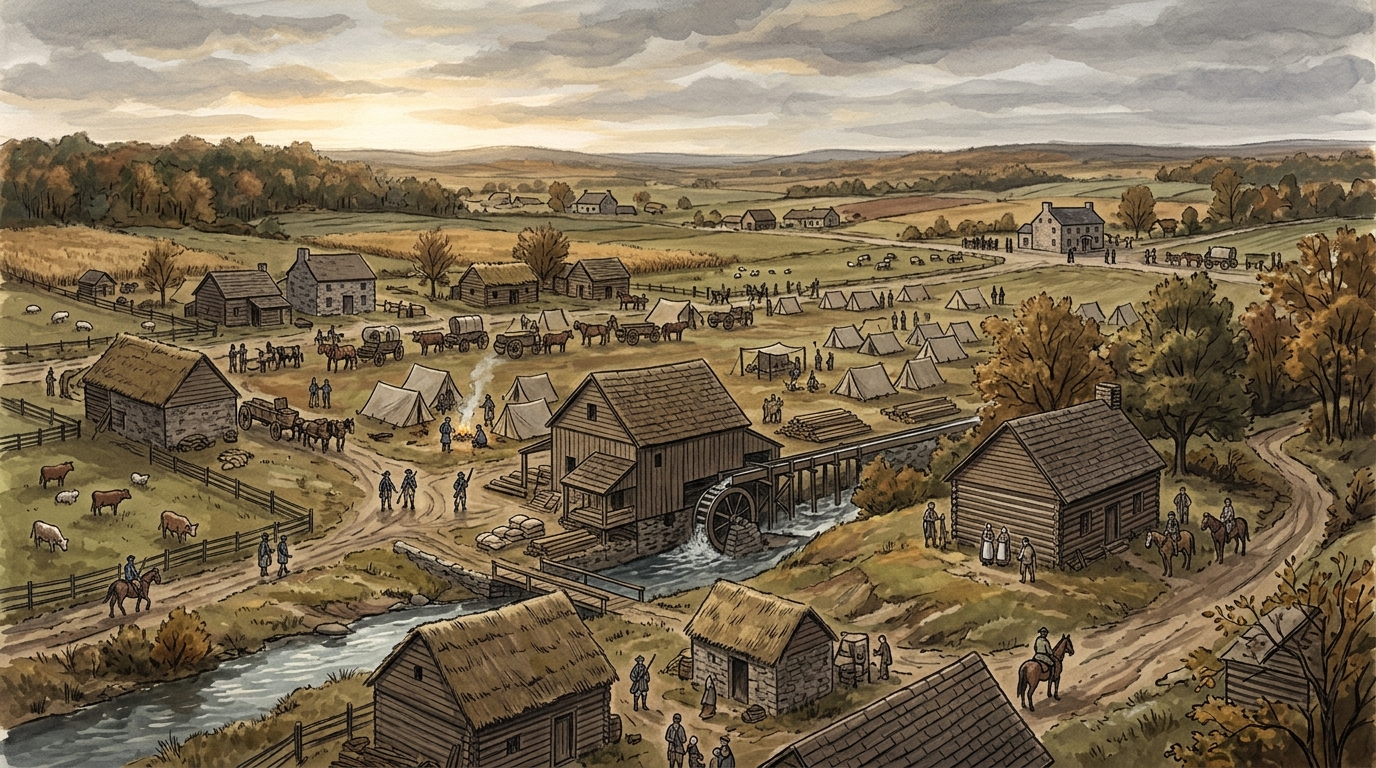
Looking around
You stand in a rural township that is still legally part of Philadelphia County2, not Montgomery County. Around you are farms held by Germanic families1, with fields, barns, cattle, and roads that run toward churches and mills. A Mennonite meetinghouse3,4 has stood here for decades, and nearby plain-sect families keep worship close to home. Along the East Branch of the Perkiomen, Garrett Clemens’s mill site3 shows how grain and timber become flour, meal, and lumber. The roads are not paved streets; they are roads and trails connecting churches, mills, farms, and taverns3. A tavern or store may mark a crossroads, but Harleysville and Lederach are still small rural centers1,3, not later railroad suburbs. In 1777, the place is not remote from war: Continental soldiers, wagons, and animals camp on Lower Salford fields8, and militia officers list township men for service.
Work
Farms, mills, trades
Farming was the chief livelihood1, but the township also needed tinsmiths, harnessmakers, weavers, and carriage-makers1. Grain and timber moved through the East Branch of the Perkiomen mill site3.
Faith
Plain churches nearby
The religious map was close and local: a Mennonite meetinghouse existed by 17283,4, and Schwenkfelders settled especially in eastern Lower Salford3. These were peace-church communities in a decade of war.
Law & power
County court, new state
Local government still ran through Philadelphia County2, since Montgomery County did not yet exist. During the Revolution, the new state demanded allegiance under the 1777 Test Act and its supplement7.
What people feared
War in the fields
The danger was not abstract in 1777: Continental soldiers, wagons, and animals camped on Lower Salford fields8. The memory of death entered the local ground with eight unknown Continental soldiers buried near Fretz Road8.
Money
Shillings and labor
Small sums mattered: a cattle notice offered fifteen shillings for four strays5, and even a bell on one heifer was valued at three shillings. Labor could be bound by Atlantic debt, as in the carpenter whose ship freight was paid by local employers5.
Who lived here
German-speaking farmers
The township was shaped by Germanic settlers from Germany, Switzerland, and Holland1. Many families used German or a German dialect1 in daily life.
Roads & news
Roads, taverns, notices
News and strangers came by roads and trails connecting churches, mills, farms, and taverns3. Printed notices mattered too, as when a Lower Salford cattle owner advertised lost animals and a reward5.
Home & table
Rural, not suburban
The settlement pattern was farm-centered: Harleysville, Mainland, Lederach, and Vernfield were not yet later suburban villages1,3. The most honest gap is that ordinary Lower Salford houses in the 1770s are not described in the online sources found here.
Year by year
- 1770Salford Mennonite’s original meetinghouse was replaced by a larger one about this year. here3,4
- 1774The First Continental Congress met in Philadelphia, close enough for Lower Salford travelers and market people to hear political news quickly. nearby
- 1776Independence was declared in Philadelphia, turning provincial politics into a test of loyalty for townships such as Lower Salford. the country
- 1777Pennsylvania required allegiance assurances from white male inhabitants and allowed suspected unfriendly men to be jailed if they refused. the country7
- 1777Lower Salford men were listed in the Philadelphia County militia as the 1st Company under Captains William Tennis and Andrew Campbell. here6
- 1777Continental soldiers camped on Lower Salford fields after the Battle of Germantown. here8
- 1778The French alliance with the United States widened the war against Britain and would have been discussed wherever Revolutionary news arrived. the world
- 1781Cornwallis surrendered at Yorktown, news that reached Pennsylvania before the war was formally over. the country
What the sources say
- In the 1770s Lower Salford lay in Philadelphia County; Montgomery County was not created until September 10, 1784. from the sources2
- Lower Salford had been separated from the older Salford Township by the Philadelphia County Court of Quarter Sessions in March 1741. from the sources1,3
- The township was part of a wider Salford world that also produced Upper Salford, Marlborough, and later Salford Township. from the sources1,3
- Lower Salford’s early settlers were described locally as mainly Germanic immigrants from Germany, Switzerland, and Holland. inferred1
- German or a German dialect, later called Pennsylvania Dutch, was the ordinary language of many Lower Salford families. inferred1
- Farming was the chief livelihood because the early settlers came largely from agricultural backgrounds. inferred1
- The local village centers grew around inns or taverns and general stores, with craftsmen such as tinsmiths, harnessmakers, weavers, and carriage-makers. inferred1
- A Mennonite meetinghouse existed in Lower Salford by 1728, and Salford Mennonite records say the original meetinghouse was replaced by a larger one about 1770. from the sources3,4
- The Schwenkfelders, another plain religious group, settled especially in the eastern part of Lower Salford. from the sources3
- Manufacturing for local needs began early: Garrett Clemens built the first township mill along the East Branch of the Perkiomen in 1726. from the sources3
- Church and mill formed local centers, and a network of roads and trails connected them with farms and other parts of the community. from the sources3
- Harleysville, Mainland, Lederach, and Vernfield were later-named township villages, but in the 1770s the landscape remained chiefly rural and agricultural. from the sources1,3
- The old Manatawney Trail was adapted into a road, but Sumneytown Pike as a named pike was not created until 1847. from the sources3
- A 1745 Lower Salford cattle notice offered fifteen shillings for the return of four strays, including a heifer wearing a three-shilling bell. from the sources5
- A 1753 Lower Salford day book entry records two brothers paying half each to redeem a carpenter’s ship freight and agreeing to clothe him while he worked. from the sources5
- Pennsylvania’s 1777 Test Act required white male inhabitants above eighteen to give assurances of allegiance, and a later 1777 supplement targeted travelers and suspected unfriendly men above sixteen. from the sources7
- In October 1777 Continental soldiers camped along Skippack Creek, on Lower Salford fields, and on farms near Fretz Road after the Battle of Germantown. from the sources8
- Brigadier General Casimir Pulaski and his cavalry staff stayed at the Lower Salford farmhouse of Schwenkfelder preacher and farmer Christopher Hoffman for nine days in October 1777. from the sources8
- Eight unknown Continental soldiers were later remembered as buried in the Kriebel family burial ground near Fretz Road after the 1777 encampment. from the sources8
- Lower Salford Township appeared in the Philadelphia County militia organization of 1777 as the 1st Company under Captains William Tennis and Andrew Campbell. from the sources6
- Because Mennonites and Schwenkfelders were peace churches, many local families would have faced pressure over militia service, loyalty oaths, fines, and wartime supplying. inferred
- No online source found in this quick search gives a 1770s population total for Lower Salford itself. not known
- No online source found in this quick search describes the exact size, materials, or interior arrangement of ordinary Lower Salford houses in the 1770s. not known
Sources
- The History of Lower Salford Township. Lower Salford Township
- History. Montgomery County Recorder of Deeds
- Lower Salford Township, Montgomery County, Pennsylvania. Living Places
- Salford Mennonite Church (Harleysville, Pennsylvania, USA). Global Anabaptist Mennonite Encyclopedia Online, 1959
- Glimpses of “Skippack” Mennonite Life, 1745–1760. Mennonite Heritage Center
- Philadelphia County Revolutionary War Militia. Pennsylvania State Archives
- The Statutes at Large of Pennsylvania, 1777, Chapter 765. Pennsylvania Legislative Reference Bureau, 1777
- The Continental Army in Towamencin, October 8–16, 1777. Towamencin Township
Nearby, about the same time
Did someone of yours live here?
Give Yore one name and it goes looking for the family, then tells it back as a film set in places like this one, with the record behind every sentence.
Researched by Yore’s AI historian (gpt-5.5) in October 2026 from the sources above. It is about the place and the time, not about any person. Statements marked “inferred” are conclusions drawn from the sources, not records. Also available as plain Markdown. To cite: Yore, “Lower Salford Township, Montgomery County, Pennsylvania in the 1770s”, yorehistory.com/place/lower-salford-township-montgomery-county-pennsylvania/1770s